
Jamaica's ports are getting closer attention. Earlier this year, the Government approved a security assessment of Kingston Wharves, Kingston Freeport and Montego Bay, led by the United States Department of State with AECOM as implementer. It is reviewing current capabilities, identifying gaps and setting out a phased roadmap — with recommendations aligned to the International Ship and Port Facility Security (ISPS) Code.
National investment of this kind raises the bar for everyone in the port environment: terminal operators, logistics companies, bonded warehouses, ship agents and the contractors who move between them. When the main gates get stronger, attention turns to the weaker links around them.
Where compliant plans fail in practice
The ISPS Code requires a port facility security plan, a security officer, defined security levels and regular drills. Most facilities can show all of these on paper. The gaps we look for are in how the plan is carried out day to day.
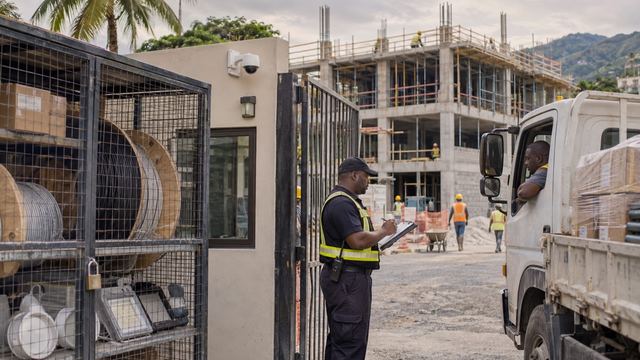
Access control at the gate. Passes are checked at the start of a shift and not afterwards. Vehicles are waved through when queues build. Temporary passes are issued and never recovered.
Contractor and visitor movement. Contractors are escorted in and then left alone. Their access is not limited to the areas they need, and nobody checks when they leave.
Drills that rehearse the easy version. Exercises are scheduled, announced and run in daylight with full staff. Real incidents happen at shift change, at night, or during a storm.
Security levels that don't change behaviour. When the security level rises, staff should know exactly what changes for them. Often, only the notice board does.

The supply chain beyond the fence
Port security does not end at the facility boundary. Warehouses, yards and transport companies that handle cargo before and after the port are part of the same chain, even if they are not covered by the Code. A weakness there can undo good controls at the terminal.
What this means in practice
- Test access control unannounced, including at night and at shift change.
- Limit contractor access to defined zones, and log exit as well as entry.
- Run at least one drill a year under realistic conditions.
- Write down what each team does differently at each security level.
- Extend your review to off-site warehouses and transport partners.
Compliance is the starting point. Readiness is what protects the operation.
Talk to us about a port facility security assessment. → Security assessments & surveys
Sources: Jamaica Gleaner, 29 June 2026.